

Ever since writing previews for each of the offensive position groups (QB/RB/WR/OL) earlier this summer, I’ve struggled with how to approach the defense. With Jim Knowles taking over as defensive coordinator, and his reputation as somewhat of a mad scientist, it’s hard to know what exactly to point out as strengths and weaknesses of the defensive position groups, as we don’t really know the specifics of what they are going to be asked to do. So, as a starting point, I’m just going to discuss defense in general, how we got to where defenses are today, and where Knowles might be taking the UT defense in 2026 and beyond.
Evolution of the Strong Side
If you’re old enough to remember John Chavis as Tennessee’s defensive coordinator, you remember a time when practically every team ran either a 4-3 (four down linemen/three linebackers) or 3-4 (three down linemen/four linebacker) defense. There are many differences in the two but I like to mainly think about an odd-front (3-4) being a two-gap defense, meaning the down linemen are responsible for reading the play and closing one of the two gaps to either side of the man in front of them. In an even front (4-3), the down linemen are assigned a gap to close depending on the scheme called for that play. Especially in the 4-3, which is what Chavis’ teams ran, the main job of the linemen was to close gaps so that the linebackers could flow to the ball and make the tackle.
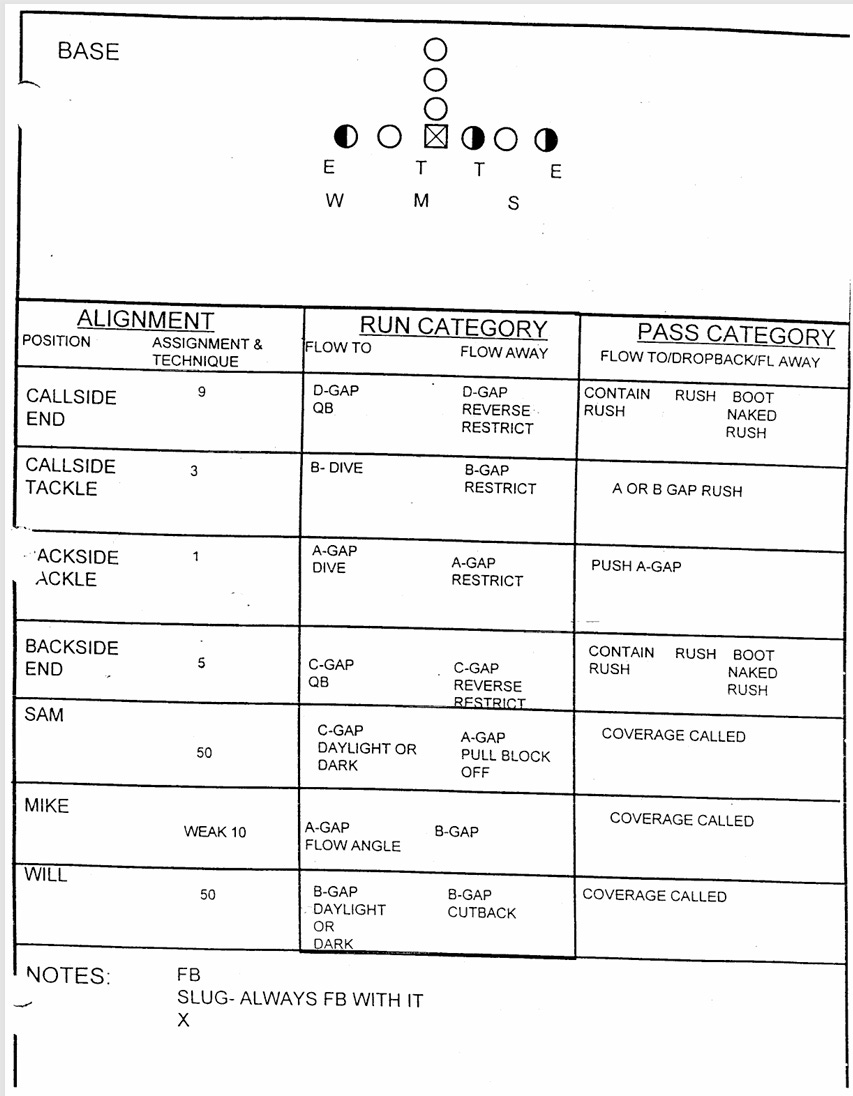
In that 4-3 defense, one side of the offense's formation is declared the strong side, usually based on which side the tight end lined up on. That strong side linebacker’s main job was to take on lead blocks from the TE or fullback, allowing the middle or weak side linebacker to come in for the tackle. Here’s a page from the 2002 Tennessee defensive playbook showing the defensive front’s alignments:
and another showing coverage responsibilities in Cover 2:
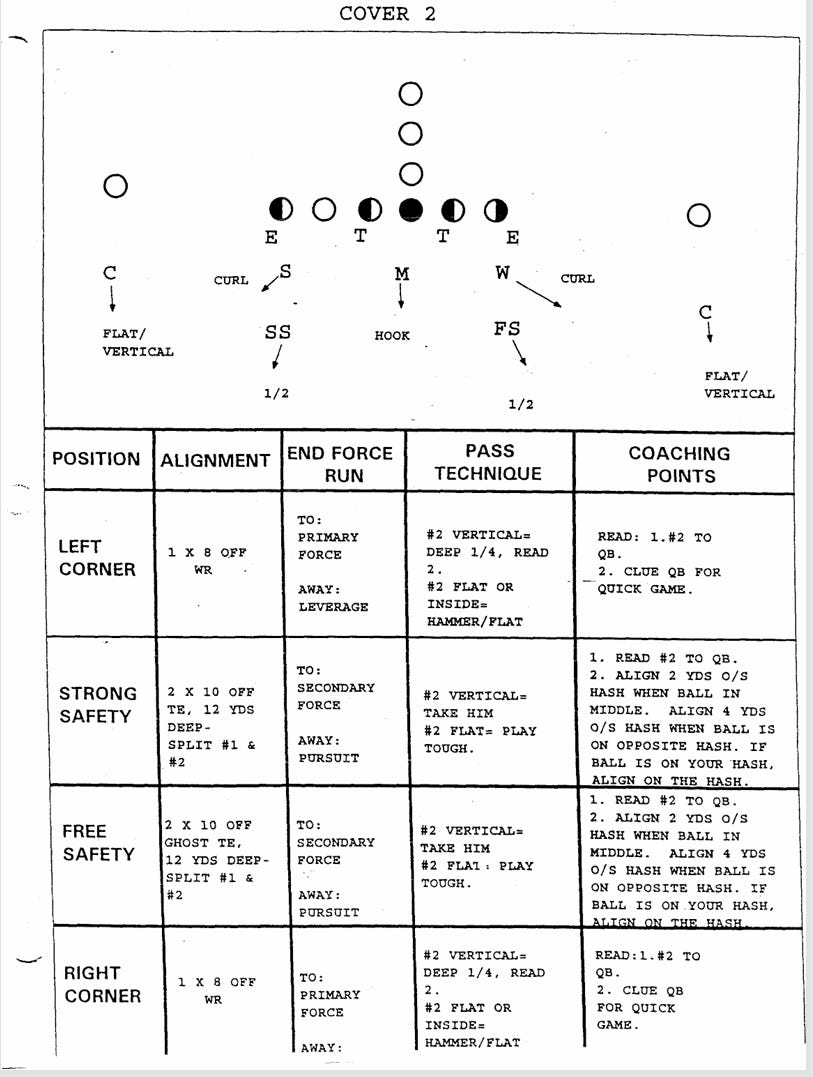
These were pretty standard in the 1990s.
Then something happened. Offenses stopped running the ball at a 55-60% clip as they had through the 80s and 90s. Concepts like the Mike Leach’s Air Raid and Urban Meyer’s Spread Option proliferated throughout the game. The I formation and fullbacks started to disappear, and later tight ends were virtually gone, or at least their roles largely transformed. Suddenly, you couldn’t declare the TE side the “strong side”, as there was no longer a likelihood of the ball being run to that side, or being run at all as offenses started throwing at around a 50% clip or more.
Instead, the “strong side” became the passing strength of the offense. In college football, due to the wide hash marks roughly dividing the gridiron into thirds, that is usually the “field” or wide side. The strong side linebacker went away, replaced by a totally new position often called the “star”. The star back is a hybrid LB/DB that can have run-stopping or pass-defending duties depending on the DC’s approach and/or the opponent’s strengths.
As the back end of the defense evolved with this new 4-2-5 formation, so did the defensive line. In the 4-3 you needed beefy defensive tackles to fill run gaps and eat double teams. You also needed ends that were still big enough to take on OTs, TEs, and fullbacks, but athletic enough to rush the passer, too. In the new 4-2-5, those duties became more specialized. You still have beefy tackles; one is usually a little beefier and lines up over the center, and one still quite beefy boy lines up in a 3 technique, or over the guard’s outside shoulder. Then there is often a run-stopping type defensive end and a pass rush specialist (“edge” or “leo”).
I know that a lot of this is remedial for many of you. but I also think it is important to review the evolution of modern defense to understand what Jim Knowles could be about to unleash in Knoxville.
Enter the Mad Scientist
When he was hired by Oklahoma State, Knowles brought a background in the 4-2-5 philosophy from his time at Duke. In Stillwater, he adapted to the explosive spread offenses of the Big 12 by morphing his defense into an Odd Front-based 3-high safety system. During this era, he utilized Dime personnel—often spinning a safety down to a weakside linebacker position—and three-down pre-snap alignments to disguise coverages. He was characterized during this period as a “light box guy” who utilized horizontal gap-squeezing to control the run. Here’s an example of a typical 3-3-5 look that Knowles used at OK State:
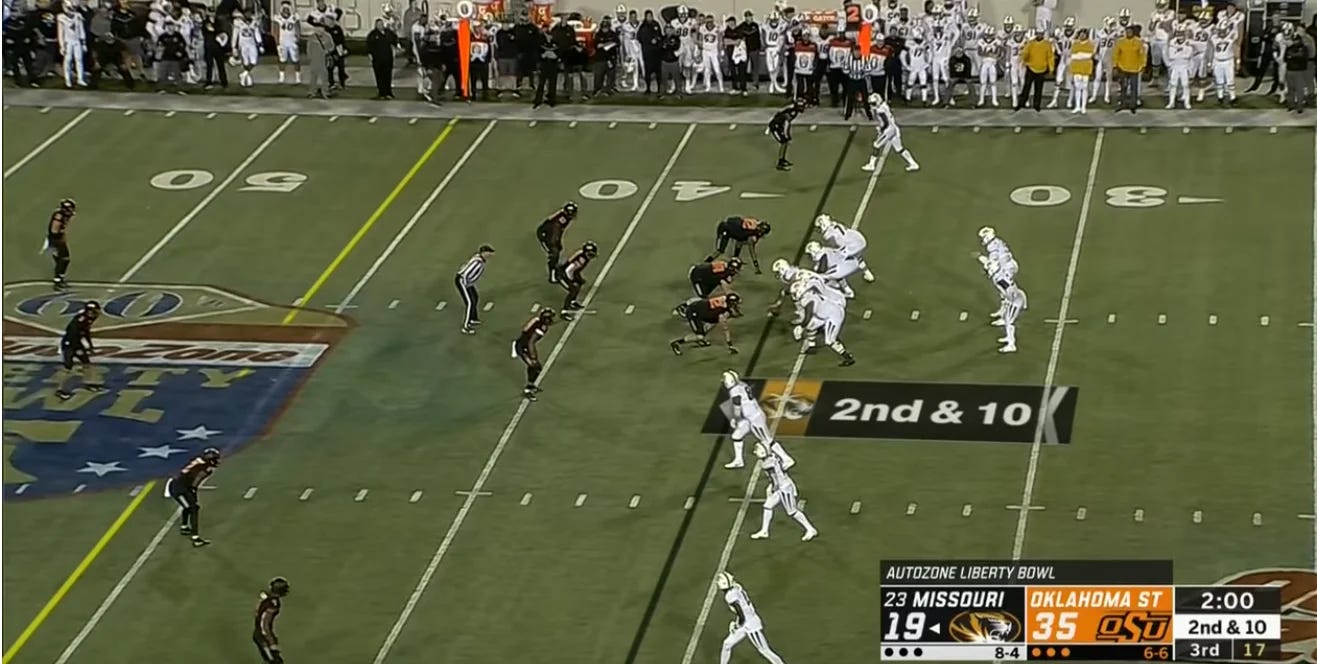
Upon his move to Ohio State, Knowles fused his 3-high safety concepts with a four-down front to leverage Ohio State’s plethora of elite defensive line talent. The same Ohio State unit that plagued UT in the 2024 playoff game and went on to win a National Championship was highly “multiple,” capable of jumping from a 4-2-5 into a 3-high alignment mid-game to confuse offensive coordinators.
Knowing his history, what defense will Knowles use at Tennessee? 4-2-5? 3-3-5? 3-High Safety? Old school 4-3? I think the answer is, “yes”. I’d expect the Vol defense to be truly multiple this season, with a little bit of all these concepts used at different times. So how does UT’s current roster fit with the demands of these various schemes?
Personnel
Interior Defensive Line
Regardless of the defensive formation, Tennessee is unlikely to play a true odd-front defense in the sense of the old 3-4 popular in the 1970s and 80s NFL. In that defense, the nose guard was tasked with “two-gapping”, i.e. being responsible for the running lane on both sides of the center. Tennessee will likely line up in what look like odd fronts this year (three or five across the line), but it is far more likely that whoever is lined up opposite center will have just one gap to attack.
Still, you want a big dude for the job, and the Vols have a few options. The prototypical nose is in the neighborhood of 6’2 to 6’5 and 320 to 350 lbs. UT doesn’t really have anyone who fits that bill right now like Elijah Simmons (6’2/340) and Omari Thomas (6’4/325) did in 2024. Here’s what UT’s D-Line room looks like for 2026, with PFF’s log of where each lined up in 2025 by snap count:
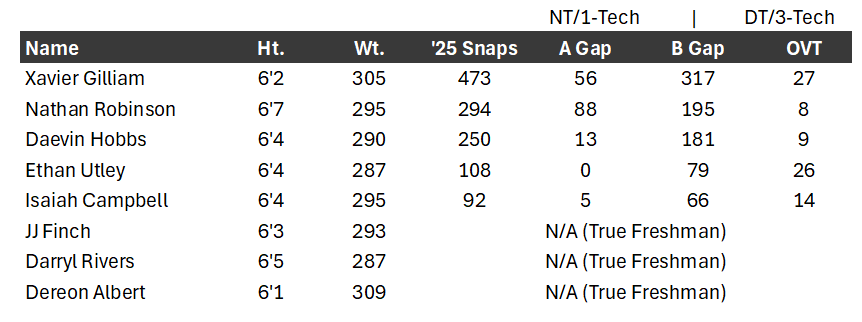
“OVT” is over the tackle in PFF’s parlance. Basically, Gilliam and Robinson have the most experience in lining up over center/in the A gap (though neither are truly “NT prototypes), while Hobbs and Utley are more used to the B gap. That’s likely what you’ll see in 2026 (although Hobbs is now an injury concern late in Fall camp). They all mostly fit the prototype of a defensive tackle: similar height to a NT, but more in the 285-310 range. But as long as the scheme accounts for all six gaps (A-B-C gap to each side, plus containing any runs outside), your run fit doesn’t actually require anyone to fit a particular size, and having a lighter defensive interior could actually pay dividends against pass-heavy SEC offenses. And with how deep Tennessee’s linebacker corps is, Jim Knowles can get real creative in how he uses the LBs to fit those gaps as well.
Linebackers
The prototypical linebacker is around 6’1 to 6’4 and, depending on how you want to use him, anywhere from 230 to 260 pounds. In the traditional 4-3, the Will or weakside LB is going to be on the lighter and faster end of the spectrum. The middle or Mike linebacker needs to be light enough to not be a coverage liability while having enough led in his seat to lay the wood on a running back with a head of steam. And in the traditional sense, the Sam or strongside backer is going to be the heaviest and hardest to move, able to stuff oncoming blockers. If you’re playing a two-linebacker defense, then you’re likely to be using the Will and Mike types, although that can adjust depending on offensive personnel.
Tennessee just happens to have talented dudes that fit the physical molds of all those LB types. It’s interesting to see the breakdown of where each one lined up in games last year according to PFF:
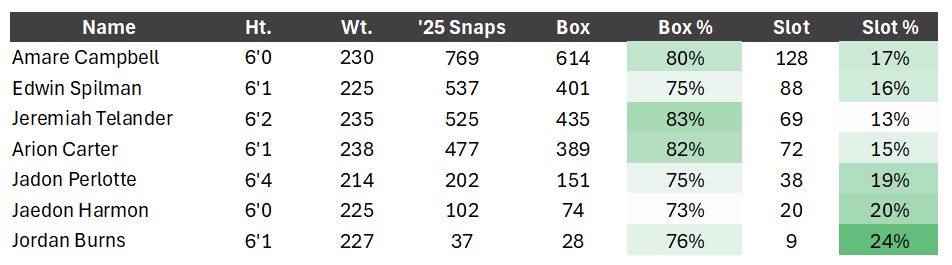
“Box” in this case means “lined up like a traditional linebacker” and “slot” means the player was lined up more like a nickel or star. And you can see that the lighter players played more on the outside, while heavier players played more traditional linebacker roles. Of course, Amare Campbell’s snaps came at Penn State.
But there’s actually a PSU linebacker from 2025 that I find more interesting when looking at the snap counts on PFF. PSU LB Keon Wylie lined up on the line 40% of the time, almost as much as he lined up in a traditional linebacker position (46%). And his remaining snaps were in the slot. If nothing else, it seems to show that Knowles isn’t beholden to traditional position labels. And it makes a player like Jeremiah Telander an interesting case. You’d imagine that Carter and Campbell will play the bulk of Tennessee’s linebacker snaps. But if Knowles can get creative with Telander like he did with Wylie, he could really unlock the full potential of a player that has been lauded for his toughness and football instincts, but criticized for his sideline-to-sideline speed. In that kind of a wildcard role where he’s depended on less to roam the whole field and rather given specific ways to create havoc, Telander could be one of UT’s best defenders in 2026.
Defensive Ends
The Vols’ situation at DE could require Knowles to get imaginative when it comes to pass rush. UT is pretty well set when it comes to big run-stuffing DEs. Tyree Weathersby, Marion Dye, and Jordan Norman are all 260+ dudes who fit the mold of a gap-controlling edge setter. But over the past several years of watching a 4-2-5 defense, Vol fans have become used to the James Pearce/Joshua Josephs LEO edge rushers too.
That could’ve been Jordan Ross’ spot, but he’s gone. It could’ve been Chaz Coleman’s spot, but he never really arrived. As is, UT has some nominal Edge rushers who are unproven; Kedric Golston II and Christian Gass will likely get shots there (Gass is a kid I’ve had high hopes for and would love to see him flash at the spot). But it’s uncertain if Tennessee has a true rush end that will fit the role like Pearce/Josephs. It’s probably the most glaring weakness the Vols have up front.
Defensive Backs
In the interest of getting this preview done before we hit a real game week, I probably didn’t do the DEs justice, and I’m really not going to be able to give you much on the DBs. To my knowledge, Tennessee cross-trains many of the DBs at multiple positions, and I believe the defensive backfield is another place you will see Knowles’ get creative.
At CB you will almost certainly see Ty Redmond, who grew by leaps and bounds after being baptized by fire as a true freshman last year. The other corner should be Auburn transfer Kayin Lee, although it seems I’ve heard sophomore Tim Merritt’s name mentioned quite a bit this fall camp. How will Knowles use the Star/Nickle spot (which will likely be Kansas State transfer Qua Moss most of the time)? Is Moss just coverage guy? And is there a true hybrid LB/DB type to play the 4-2-5 style Star? Do we see a speedy LB like Jadon Perlotte slide over in that role? And how deep is UT’s safety room after the season-ending loss of Edrees Farooq? Can Knowles run his three-high safety defense with what the Vols have? Was that ever even part of the plan?
And that’s what is exciting about Tennessee’s defense in 2026. Going into the season, we have a ton of questions. However, seeing how those questions get answered is going to be fun. There’s also good reason to think the defense will be a good bit better than last year. Think about how unlucky Tennessee was in some of 2025’s losses. Would a slightly better defense have possibly won a couple of those games? And with a couple more wins and a 10-year season, would you feel substantially better about last year’s team? And if that 2025 was a slightly better defense away from 10 wins, what could 2026 do with a defense that will likely be much improved?