


Footballs are weird. They’re oblong, for one thing. Almost every other ball sport is played with a sphere. Sure, there are nuances to those spheres: the seams on a baseball will affect it’s flight, as will any scuffs or substances on it. But it comes from the factory pretty dang close to spherical; at least much more so than a football. This is true of basketballs, tennis balls, golf balls. Things like composition and air pressure will affect them, but for the most part, you can replicate the same bounce from any one of those balls 99% of the time. Throw it against a wall, and it will come right back to you.
Not footballs. Go out to the garage and bounce the football a few times. You certainly can’t throw it like a football is meant to be thrown and have it bounce back to you. If you throw it on it’s side it’s not impossible to get a replicable bounce, but it’s dang hard. It takes a lot more effort than dribbling a basketball. And just a little variation in how the ball hits can make a huge difference in how it rebounds. If it hits on the laces, you’re probably chasing it down the driveway.
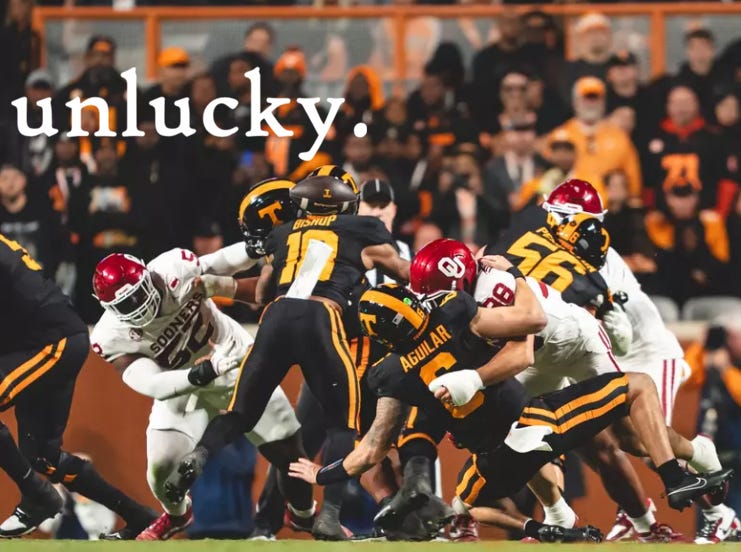
That’s why on November 1st, in the first quarter of Tennessee’s game against Oklahoma, you saw what might have been the unluckiest play of the season. “Luck” is not a subjective term here: there are a few ways that “luck” is measured analytically in football, and one of them is by fumbles lost. Fumbling itself might be a skill issue, but losing a fumble is attributed to luck because of the odd shape and unpredictable bounce of the ball itself. Both the median and mode team in college football only lose a fumbled ball about 46% of the time. Indiana was incredibly lucky in this regard in 2025. The Hoosiers fumbled 8 times in 16 games and only lost one of them: just a 12.5% lost fumble rate. Boston College was the unluckiest team with 90% of their fumbles lost (9 lost fumbles out of 10 times they put the ball on the ground). Tennessee was overall somewhat lucky in 2025, losing 6 of 16 fumbles, or 37.5%: better than average and around the bottom of the upper-third of all teams.
Additionally, teams recover their own fumbles substantially more when the fumble occurs in the backfield. That makes sense—when the ball is fumbled in the backfield there are going to be more offensive players in the vicinity when compared to a fumble 20 yards downfield, where there might only be the fumbler himself around to fall on the ball in the midst of several defenders.
That’s what makes R Mason Thomas’ strip-sack-fumble return for Oklahoma so unlucky for the Vols. On 1st-and-10 at the Sooners’ 24, Joey Aguilar looked left, got smacked from behind by a blitzing OU LB (assisted by an uncharacteristic whiff of a block by RT David Sanders), and fumbled a ball that took one perfect bounce right into the free hand of an onrushing Thomas, who barely broke stride on his way to the endzone for a game-tying touchdown. It took the trifecta of bad luck: a team that loses fumbles less frequently than most, a defensive recovery in the backfield, and bounce that you couldn’t replicate more than two times out of ten. Any one of those elements are unlikely to happen, all three happening on the same play is hardly fathomable. Depending on how optimistic or pessimistic you are, this was a 14-, 10-, or 7-point swing in a game ultimately decided by six points.
And there’s another measure of luck we can dissect: how do you fare in 1-score games? Tennessee had five 1-score games in 2025: Georgia, Mississippi State, Arkansas, Oklahoma, and the Music City Bowl against Illinois. The Vols went 2-3 in those games. Indiana again was one of the lucky ones: Curt Cignitti’s crew was 4-0 in one-score games. Ole Miss was another lucky team with a 6-1 record. That was after the Rebels went 0-3 in such games in 2024. And that’s usually how it goes. Rarely does a team stay winning or losing a lot of close games year over year. For example, Arkansas State was 7-0 in one-score games in 2024. But the Fightin’ Butch Joneses regressed to the mean in ’25, going 3-4.
The Vols weren’t an outlier with their 2-3 close-game record. But however you feel about Tennessee’s 2025 season, would you feel better if those results were reversed? Record-wise it’s just one game, and on its face 9-4 doesn’t feel much different than 8-5. However wins against UGA, OU, and finishing with a bowl win likely puts a shine on a season that felt a little lackluster in the end. Heck, beating Georgia and Oklahoma probably keeps UT in the playoff hunt, even if you swap those with losses to MSU and Arkansas. (And calling that Arkansas game a one-score game is a little disingenuous; the Hogs got a couple of garbage-time scores to reel in a game that was out of hand enough for the Vols to play backups like Jake Merklinger in the 4th quarter).
Those one-score games certainly could have gone the other way too. Tennessee coughed up the ball a concerning amount of times to keep the Bulldogs alive in Starkville; that overtime could’ve gone the other way. We’ve already covered how unlucky the Oklahoma loss was, and there was another strip-sack-fumble touchdown in the Illinois game. That one happened in the endzone, but even if Tennessee had fallen on the ball for a safety, the Illini would have needed to drive for a touchdown, not just a field goal, to win the game. There’s even a world where Arkansas completes their manic 4th-quarter comeback, I suppose.
And not to reopen the wound, but Tennessee had an 83% postgame win expectancy against Georgia. That means analytically, a game that plays out with the same statistics as Tennessee-Georgia is going to be won by the team with Tennessee’s stats 83 out of 100 times. To make things worse, based on his career statistics Max Gilbert makes the game-winning kick against Georgia 8 out of 10 times. Poor execution? Yes. Unlucky? Also yes. You’d probably find a good chunk of Vol fans who, if offered, would reverse the luck in just this one game and let the Vols lose the other four close games to finish 7-6. But you can’t repeat the past, old sport. No amount of “should’ve” will put that ball through the uprights now.
So what’s the lesson then? If none of these outcomes are changing, what the point of looking back on them? For one, while we look ahead to 2026, we can look back at 2025 and remember that there are individual plays that make a huge difference in how you remember a season. You don’t always win because the players are All-Americans, and you don’t always lose because the coaches are dunces. Sometimes you’re just unlucky.