

When Lance Heard transferred out of Knoxville last spring, Tennessee went looking in the portal for a new offensive tackle. The Vols landed on LSU transfer Ory Williams. I don’t know what Williams cost Tennessee in NIL money. I’d assume a guy that had some starting experience at another SEC school would demand a pretty penny. In general I don’t care what UT pays guys in NIL because I’m not the one writing the checks. I only hope that they get the best dudes available.
But are they? Williams went from presumed starter in the offseason to not starting a game so far in 2026 and playing limited snaps. Instead Jesse Perry, who started at RT last season until David Sanders was ready and then moved inside to guard, has started every game at tackle. In my opinion, Perry did an nice job at tackle in 2025, but seemed more natural at guard. Perry is a very good run blocker but struggles in pass protection, the very archetype of the road-grader offensive guard. At 6’6” Perry is a large human being. But Ory Williams is 6’8”, with a longer stride and wider wingspan. He fits the mold of a pass-blocking OT. It’s even been pointed out to me that he jogs athletically.
So why isn’t Williams starting at right tackle for Tennessee? Perry, the guy Tennessee wanted starting at right guard on 2025’s offensive line should be holding down that spot again in 2026 with Williams on the edge at tackle. That’s not what we have, though. Why?
The answer is simple: either Williams was a miss in the evaluation period and Tennessee should’ve found a different RT, or Williams came to UT with some starting SEC experience but hasn’t received the coaching needed to round into the Vols’ starter. I would pin either answer on the offensive line coach.
Before going further, I want to acknowledge the irony of what follows. Below is an indictment of Glen Elarbee, a man who gets paid a lot of money to coach offensive linemen in the SEC. It is written by a high school English teacher with two years of middle school coaching experience. I played offensive line—poorly—in high school. Those are my credentials. Elarbee was a two-time all-conference starting center at MTSU. He’s coached OL at the FBS level since 2013. Elarbee knows more about offensive line play than I could ever hope to learn. I don’t know how to coach an SEC offensive line.
But I know what I like. And I don’t like what I’m seeing from the Tennessee front.
Philosophy
When Josh Huepel’s offense started putting the SEC on notice in 2021 and ‘22, I wanted to learn as much as possible about how the Vols were becoming one of college football’s most explosive teams. In my research I found a website called CoachTube, where football coaches earn a little extra cash by selling their clinic materials online. For $20 I was able to learn about the philosophy behind Tennessee’s run game, particularly the counter game and some basics of running tempo.
A lot of what I learned from that clinic was fascinating in that it was antithetical to what I was taught as a high school offensive lineman. Tennessee doesn’t want its linemen to lock onto a blocker and run him 20 yards off the ball. Tennessee wants to shield defenders from the running back—making more of a “crack” than a “hole”. Creating creases in the defense is more valuable than devastating “on skates” blocking since you want to line up and run the next play as quickly as possible. Give the back a sliver of daylight to run through and hurry to the line is the formula for the tempo run game.
Thing is, Tennessee isn’t running tempo anymore. Not really, anyway. There’s been a semblance of it here and there, but it’s not the core philosophy anymore. And that’s fine—while there is an advantage to be had running a contrarian offense, when 40% of the league does it, you’re no longer the contrarian. In fact, Tennessee is breaking five years of tendency by slowing down the offense.
But if you’re slowing it down, why keep blocking it like you’re going fast? Why teach techniques that coaches have tried to coach out of their players for decades? Here’s an example from the Georgia Tech game earlier this year. On the play, the job of the center, #56 Sam Pendleton, is to 1) help the right guard with a double team, then 2) climb up to the middle linebacker and block him.
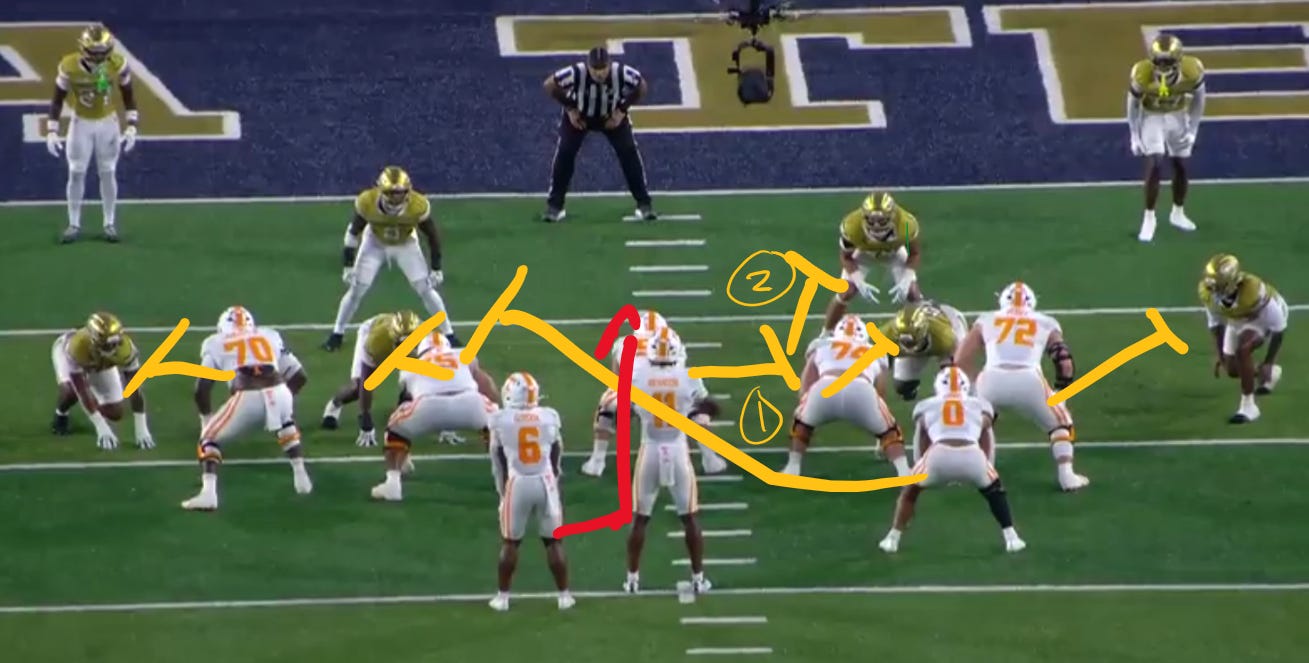
Think about how you’d attack that linebacker (#44) if you were Pendleton. Especially if you’ve ever played offensive line at any level, what would your aim point be? What angles would you take? Now look at how Pendleton actually plays it:
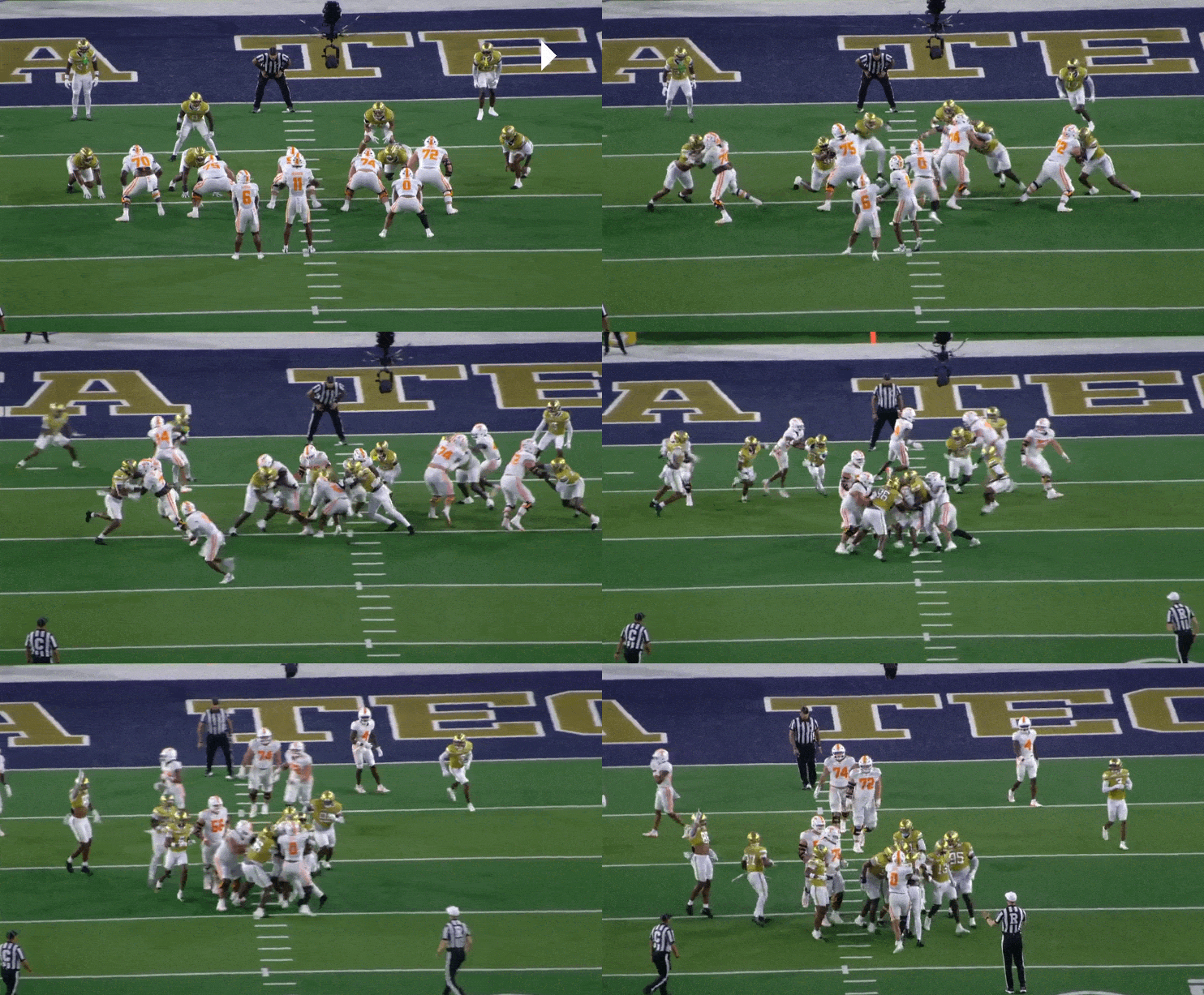
Now you might think got beat on the play. And he did, but only because he was doing what he’s coached to do. If you think the way to attack #44 there is to aim for his near hip, or the playside number on his chest, you’re thinking like the majority of offensive line coaches think. If you’ve played on the line, you were probably taught to put your face mask in the crook of his neck, or punch the playside number with your face right between the numbers. That’s now the technique is traditionally taught.
It’s not what Elarbee teaches. Tennessee’s linemen are taught to aim for the backside number. In other words, the green arrow here is where most linemen would be taught to block (especially considering the RB is trying to run off the center’s left hip). The red arrow is where Elarbee teaches his linemen to aim.
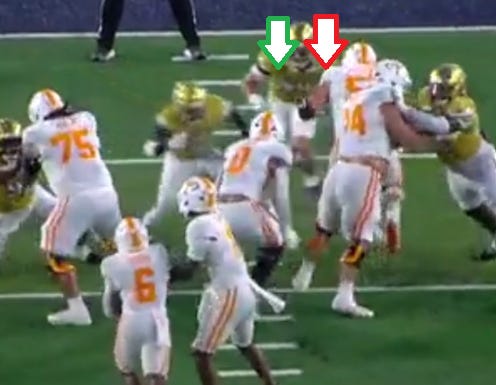
Having the lineman climbing to the backer aim for the backside number is certainly unorthodox. And Elarbee knows that. From the clinic I referenced earlier (emphasis mine):
Where I think we’re a little bit unique is that typically on that double, whoever ends up climbing to that second backer, right or wrong—I’ll probably get booed out of the clinic for this—but most people would aim… if you’re a right tackle trying to get to the Mike you’d typically aim to the playside number. We actually aim backside number. The reason we do that is one, the worst place you can get beat is underneath, I think it keeps guys from getting beat underneath. And two, it keeps us in a position where if I aim for that backside number, I can really feel when he’s going over the top of us and I can stick my left foot and bounce him over the top. But I’ll never climb too high and get beat underneath where it’s a one or two yard gain. If I get beat over the top it’s three or four yards.
When I first heard that I thought it was odd, but it does make sense if your goal is to create creases for the running back rather than blowing the defense off the ball. Don’t get beat underneath. Get the 3-4 yard gain and get to the line quick to set up the next play. On further thinking about it though, I have two problems with that philosophy. One, If you’re not going to keep the tempo game at the center of your offense, why teach techniques that the coach himself admits are not orthodox techniques, and that are only taught to aid the tempo game?
Second, and this is probably the one that bothers me more, why teach a technique predicated on the idea of getting beat? That’s one of the main coaching points here: it’s a better miss when you miss the block. I’m not naive enough to think that linemen aren’t going to get beat, especially in this league where those linebackers are often the most athletic guys on the defense. But to make that the reason for the technique seems to breed a little bit of a loser mentality, no?
Production
The strongest argument in favor of Elarbee is the elite level of Tennessee’s run game over the past six seasons. Outside of the service academies, hardly anyone runs the ball as effectively as the Vols—UT’s 37 games with 200+ rushing yards the since 2021 is only topped by Army, Air Force, and Navy. The Vols’ OL has been Joe Moore Award (given to the top OL in America) semifinalist three times.
At least one UT lineman has been 1st-or-2nd-team All-SEC every season Elarbee has coached in Knoxville, and two, Darnell Wright and Cooper Mays, earned All-American honors. Wright was a 1st-round NFL Draft pick in 2023. Cooper’s brother Cade Mays was a 6th-round pick. But neither player was recruited to UT by Elarbee. Cooper, one of the most decorated OL in Tennessee history, was not drafted.
Despite being UT’s offensive line coach since 2021, not a single home-grown (i.e., recruited and developed by Elarbee/Tennessee) lineman started for the Vols until 2025, with Sham Umarov as a part-time starter along with Jesse Perry. David Sanders, as can’t-miss a prospect as you could find, was the third.
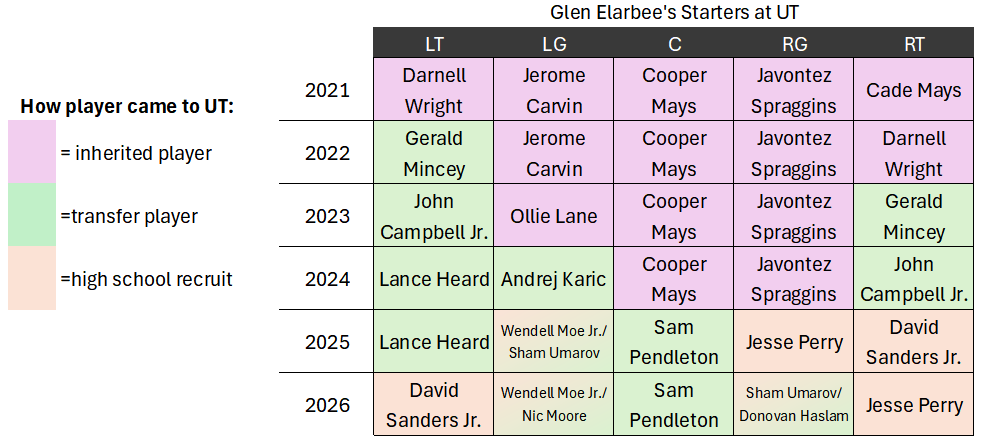
Elarbee rode the previous staff’s players until he ran out of them. He’s largely depended on transfers since then. Offensive line is one position group where freshmen rarely come in ready to play. They need time in the strength program to physically mature. So I never expected his first or even second-year lines to be filled with Elarbee’s own recruits. However, six years in I’d expect more than four Elarbee recruits to have started a game for the position coach. Especially when guys like Addison Nichols (SMU), Bennett Warren (Minnesota), and William Satterwhite (LSU) are Elarbee recruits that transferred out and currently start for other FBS programs. Why can they get the job done in those places, but couldn’t do it in Knoxville?
Protection
It’s November 2, 2026 as I write this. Tennessee is currently 6-2, 3-2 in the SEC. The losses came to Texas in a three-point game where the OL gave up 10 sacks, and a three-point game where UT had the ball and a chance to drive for a game-winning FG, but gave up a sack that resulted in a fumble and winning field position for South Carolina. The offensive line is the weak link for this team. With a marginally better OL, Tennessee would be 7-1 and in control of their SEC championship destiny, or even 8-0, and likely the #1 team in America. And that’s on a team with rotating inexperienced QBs.
I’m not a “fire the coach” guy. I’ve seen Tennessee fire enough coaches over the years to know that’s not always the solution. However, Jim Knowles has been in Knoxville for less than a year and put together a championship-caliber defense. Glen Elarbee has been in Knoxville for six years and has the glaring weak link in the chain on his hands.
I’m sure Elarbee is a great guy. I bet it’s a helluva good time to sit down with him over a couple of beers and hear stories about coaching in the SEC. And no doubt his knowledge of the game is near inexhaustible. The results aren’t there though. Elarbee has also been with Josh Heupel for ten years. It’s not likely that he’s going anywhere. To me, the best thing that could happen for Tennessee and Heupel is for him to find his buddy a nice easy job somewhere else so that he could upgrade his own staff to the championship level it’s close to being. Regardless, as long as Elarbee is in Knoxville and his line remains status quo, you won’t hear me defend him again.