


With 6:02 left in the third quarter and Tennessee holding a 21-17 lead over South Carolina, UT QB George MacIntyre dropped back and heaved a deep throw down the right sideline to a streaking Mike Matthews, who hauled in the toss and ran through the Gamecock endzone for what looked like a commanding 28-17 Volunteer lead. However, freshman WR Tyreek King had misaligned himself before the snap and was flagged for being an ineligible receiver downfield. It was the correct call. King was in an ineligible position. Tennessee would go on to punt on this possession.
Earlier in the game, with 6:22 remaining in the 2nd quarter, South Carolina faced a 3rd & 13 at their own 32 yard line. LaNorris Sellers was pressured immediately—by design, as the Gamecocks had dialed up a screen pass, and several SC offensive linemen (i.e., ineligible receivers) were already downfield blocking. Unlike the Tennessee play, ineligibles are allowed downfield on screen plays—even to engage with blocking defenders downfield—given that the ball is caught behind the line of scrimmage. Only it wasn’t. Here’s Carolina’s Maurice Brown catching the pass beyond the line of scrimmage (the black line), with two ineligible linemen blocking downfield in front of him:
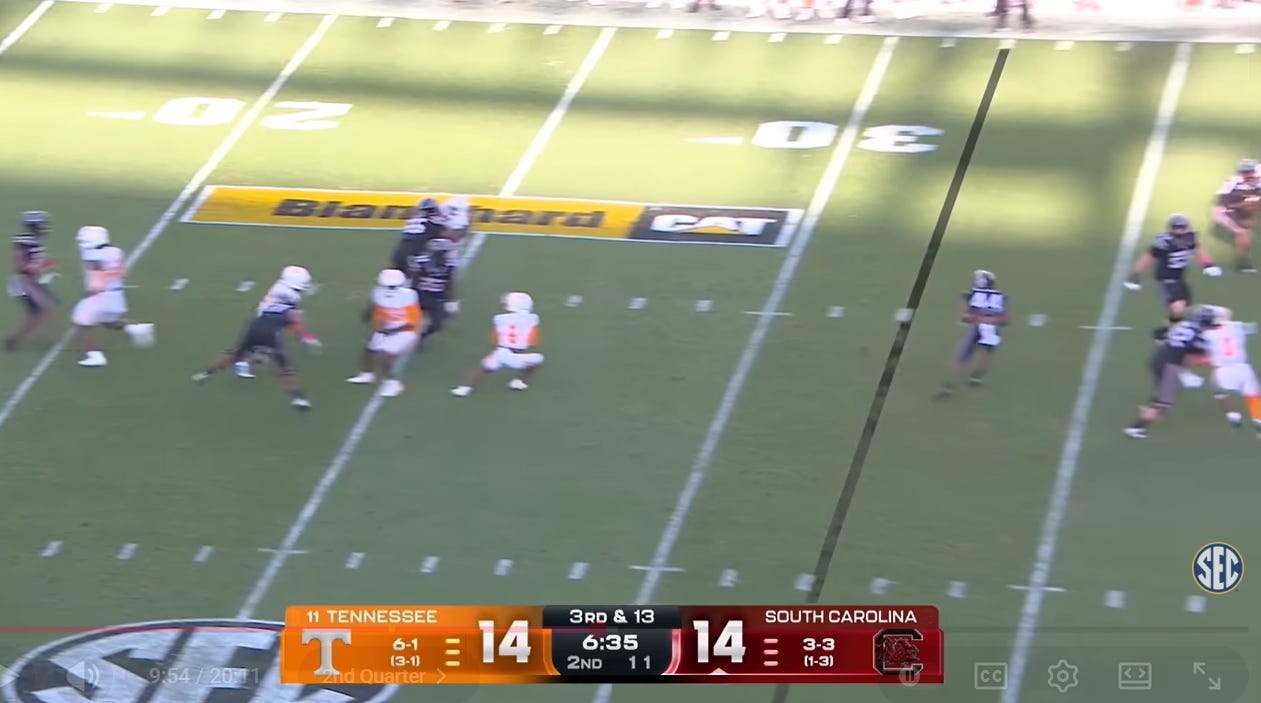
This 28-yard explosive pass play should’ve been a 5-yard penalty resulting in a 3rd-and-18 from the Carolina 27. Instead, it was 1st down Cocks in Tennessee territory. SC would go on to kick a field goal on this drive, later winning the game by that three point margin.
Why was this same rule applied unevenly on two plays within the space of less than 15 minutes of in-game time? Did the officials have it out for Tennessee in this game? We’ll never actually know. Hanlon’s Razor says to never assume malice when ignorance will suffice, and there’s a great chance that the lopsided nature of penalties Saturday were the result of ignorance rather than malice. But the optics are undeniably horrible. Start with last Sunday: Tennessee opened as a -2.5 favorite. By the end of the day, though, the line had completely flipped, and the Vols were a +2.5 road dog. Somebody put a massive amount of money on SC at +2.5 for the line to swing that hard that fast.
Then the league office assigns Alabama alum David Smith to referee the game. There’s a long list of bad Tennessee losses, especially on the road, that Smith has officiated. Again, could be coincidence, could be ignorance instead of malice. Regardless, it is borderline reckless for the SEC to assign officials to their rivals’ games, especially just one week following an emotional, high-profile rivalry game. By promoting particular named rivalries with unique logos and fanfare like the home vs. home jersey worn by UT and Bama last week, the SEC itself recognizes that some rivalries “just mean more” than others. Yet the league also allows Smith, who quarterbacked the TSIO for Alabama, to referee Tennessee’s game the week after an emotional Bama loss to the Vols. It’s likely coincidence; it’s likely ignorance instead of malice. Still, it looks horrible.
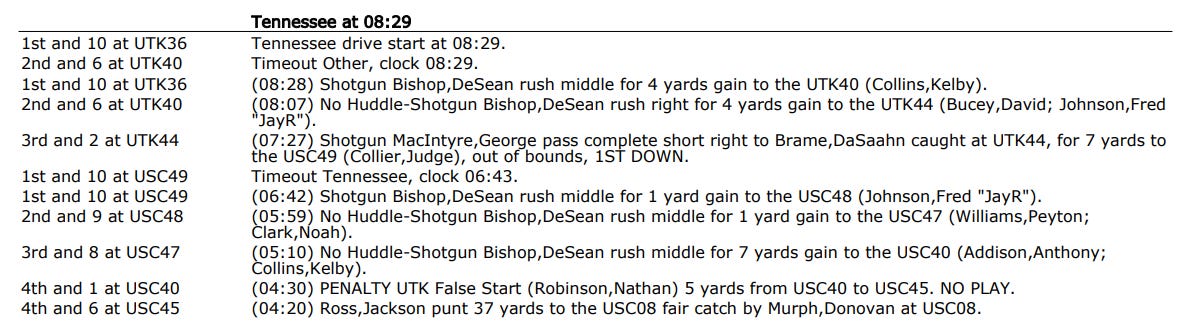
And if you think it was malicious and would like a little more fuel to your conspiracy-theory fire, below is the official play-by-play transcript of the game. This is the drive where King was flagged for being downfield. The play is not on the transcript. There is no official record of the play ever happening.
Advanced Box Score
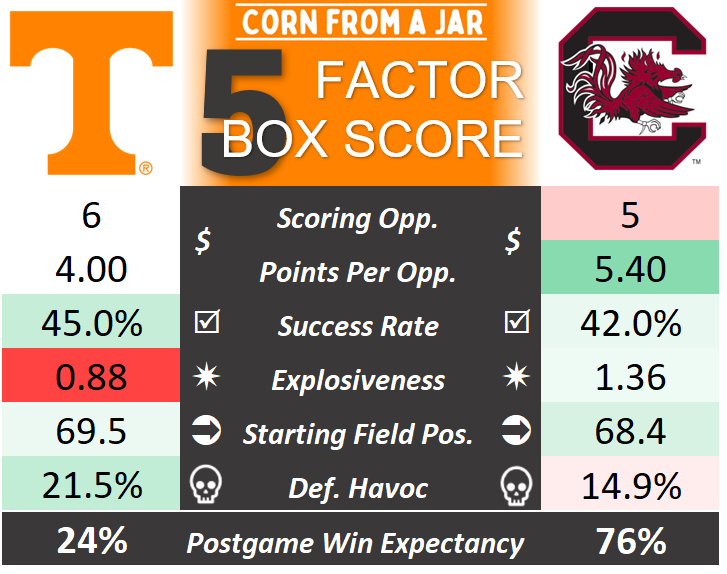
A week ago, Tennessee had about four points per scoring opportunity, and it was fine because the defense had Alabama sophomore QB Keelon Russell in a blender. But LaNorris Sellers is a veteran. Some of the same tricks Jim Knowles used against Russell weren’t going to work on Sellers, and Tennessee was going to need explosive plays to keep up. They didn’t find those plays Saturday, or at least they couldn’t keep them on the board.
Everywhere else the Vols were fine. Tennessee had a slightly better success rate, the field position battle was practically a draw, and the havoc rate was once again impressively high. South Carolina’s own havoc rate was an unimpressive sub-15%, but Dylan Stewart’s strip-sack came at just the right time.
Speaking of, back in the offseason I wrote about the unlucky nature of Tennessee’s 2025 season. Luck is measured by both fumbles lost and record in one-score games. UT was 2-3 in one-score games a year ago, they have a similar record so far this season at 1-2. And although the Vols are just on the good side of lucky when it comes to fumbles lost at 43.8% (the national average is 46%—Northwestern is particularly lucky having lost just 2 of 10 fumbles, while Oregon is on the other end with 9 of 10 fumbles lost this year), no turnover has been as costly this season as giving the Gamecocks the ball on the edge of field goal range with just a minute left.
Rushing Report
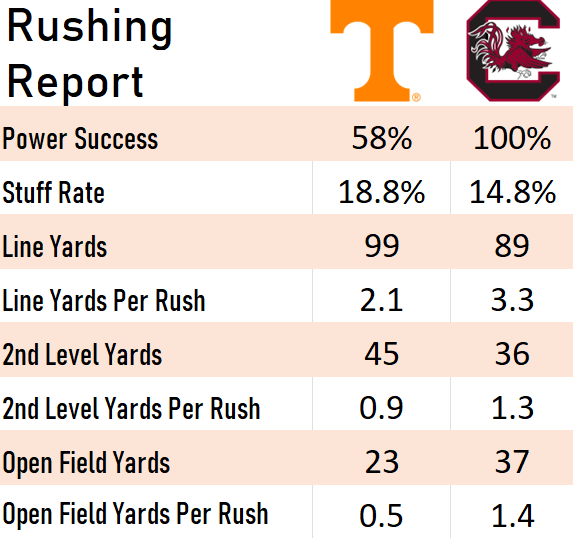
Power Success is the rate of conversion when needing just a couple of yards on 3rd or 4th down. The Vols power run game had been near flawless out of their jumbo package this season, including 6 for 6 on 4th downs at the time they lined up on 4th and 1 with just 3:37 left in the game. Converting there, as they had every time they tried in October up to that point, would almost certainly ice the game.
They didn’t.
Player Usage & PPA

This game is an interesting study in how PPA tells you how much a player impacted their team’s performance. LaNorris Sellers had a +10.6 PPA rushing and -1.2 PPA passing. In other words, Sellers was a liability when throwing, but won the game with his legs. That’s a bit of a misnomer since many of his biggest plays came on scrambles that started as pass plays. But he was much better off tucking and running than trying to throw.

Conversely, George MacIntyre had a -9.9 rush PPA and a +4.6 pass PPA. Most of that negative came on the failed 4th down and the strip-sack. MacIntyre actually had a couple of nice decisions tucking and running at the right time. I’ve had the feeling the last few weeks that GMac needed to run more, just to legitimize the possibility of a QB run on our read options and RPOs. But after seeing him execute a speed option, we might just need to leave that part of the game on the shelf.
Great summary & explanation of the ludicrous calls! At least it was a first: Never before has a college team had 3 tds wiped off the board!