


Something I used to do on this site was profile high school players who committed to Tennessee. But what with the transfer portal and players that seem a sure thing flipping their commitments, it felt a little Quixotic writing these posts at all (actually the comps on that Shaedy Hayward profile are hilarious considering how many of them never showed up for UT either).
This one seems like a big deal though, especially since there seems to be a shift in Tennessee’s recruiting strategy for the 2027 class. After busting tail on the recruiting trail the past several seasons to raise the Vols’ profile, Tennessee and Josh Heupel seem to be more focused on budgeting their NIL funds wisely between spending big on portal players and specific high schoolers who can make an impact immediately instead of highly ranked dudes who will cash a check this year just to portal out the next, with the rest of the class being players who want to come to a school like UT and develop, even if that takes some time. Or at least, that’s what the strategy looks like from a distance.
As a result, Tennessee currently sits at just #24 nationally in On3’s recruiting rankings, behind nine other SEC teams (including Kentucky). And that’s after the massive commitment of this profile’s subject, David Gabriel Georges. But that’s why the commitment of DGG was so important: if you’re going to bank the success of your class on a big splash signing, you better get him in the boat.
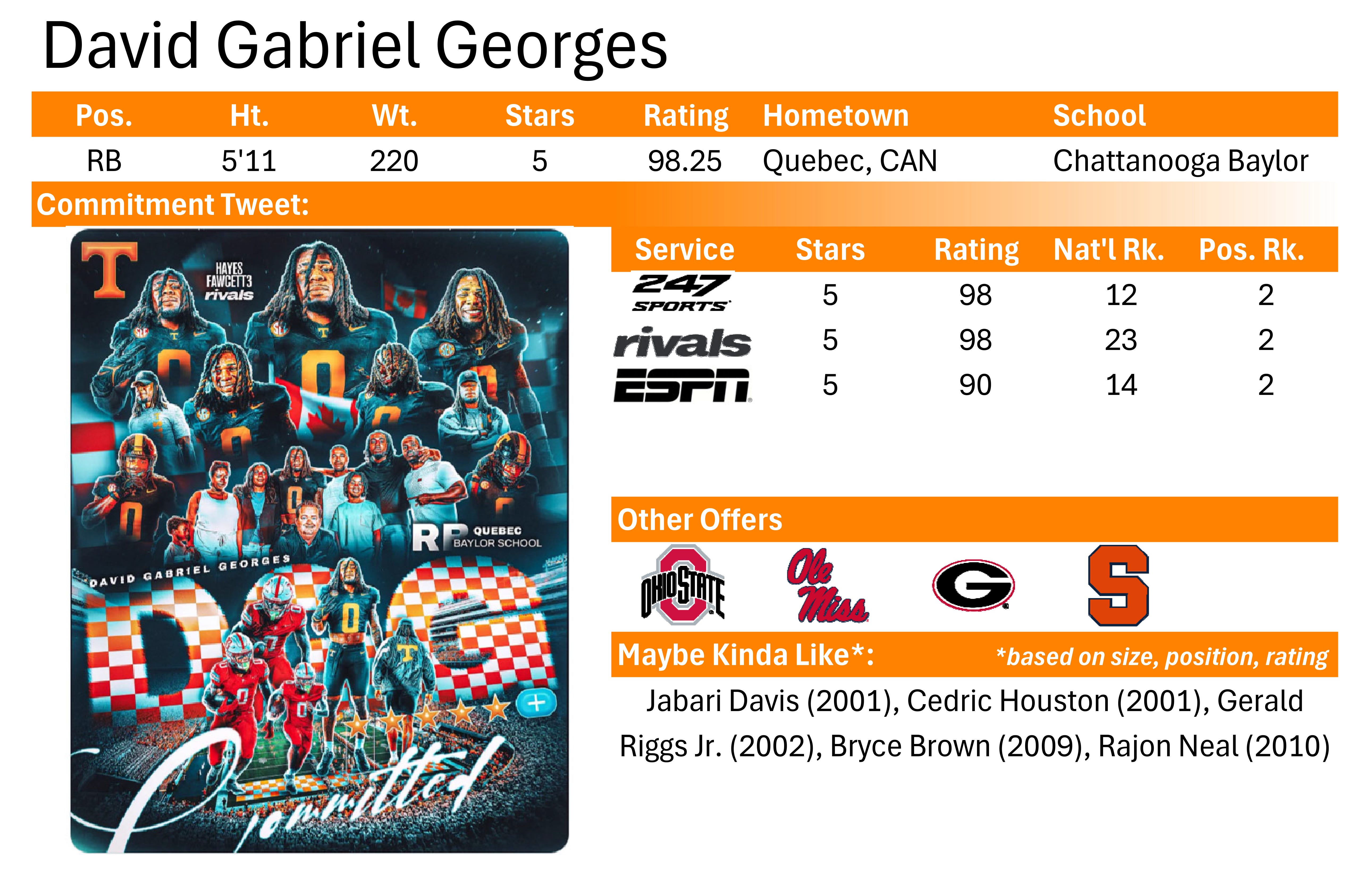
Gabriel Georges plays for the Baylor School in Chattanooga and won the TSSAA DII-AA state championship in 2025 after being a runner-up in 2024. DGG is a two-time Tennessee Mr. Football award winner and is likely the favorite in 2026 as well, having run for over 2800 yards and 41 touchdowns going into his senior year.
Rated as a “5-star plus” player and a top-10 national prospect, DGG is the #1 player in the state of Tennessee and one of the top two running backs in the country. But his recruitment wasn’t as simple as UT pulling an in-state player since DGG is a native of Quebec and speaks English as a second language, and I’m only now realizing what a blessing it was for this kid to learn English as a non-native in southern Appalachia.
Film
If you’re reading this you’ve probably seen the kid’s highlights. But for posterity:
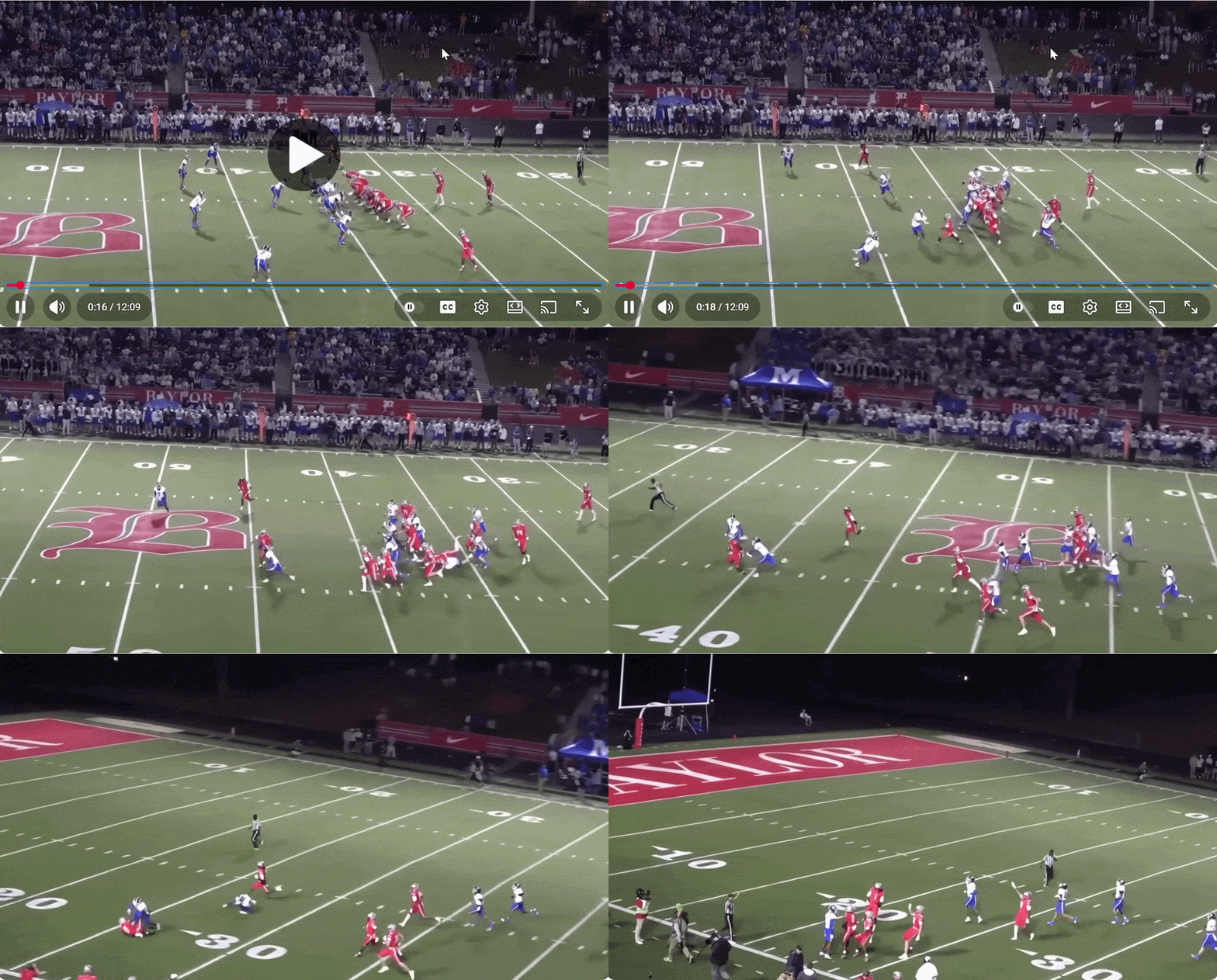
The first three plays from that compilation really show off DGG’s unique skillset. Play 1 showcases his elusiveness, explosion through contact, and speed:
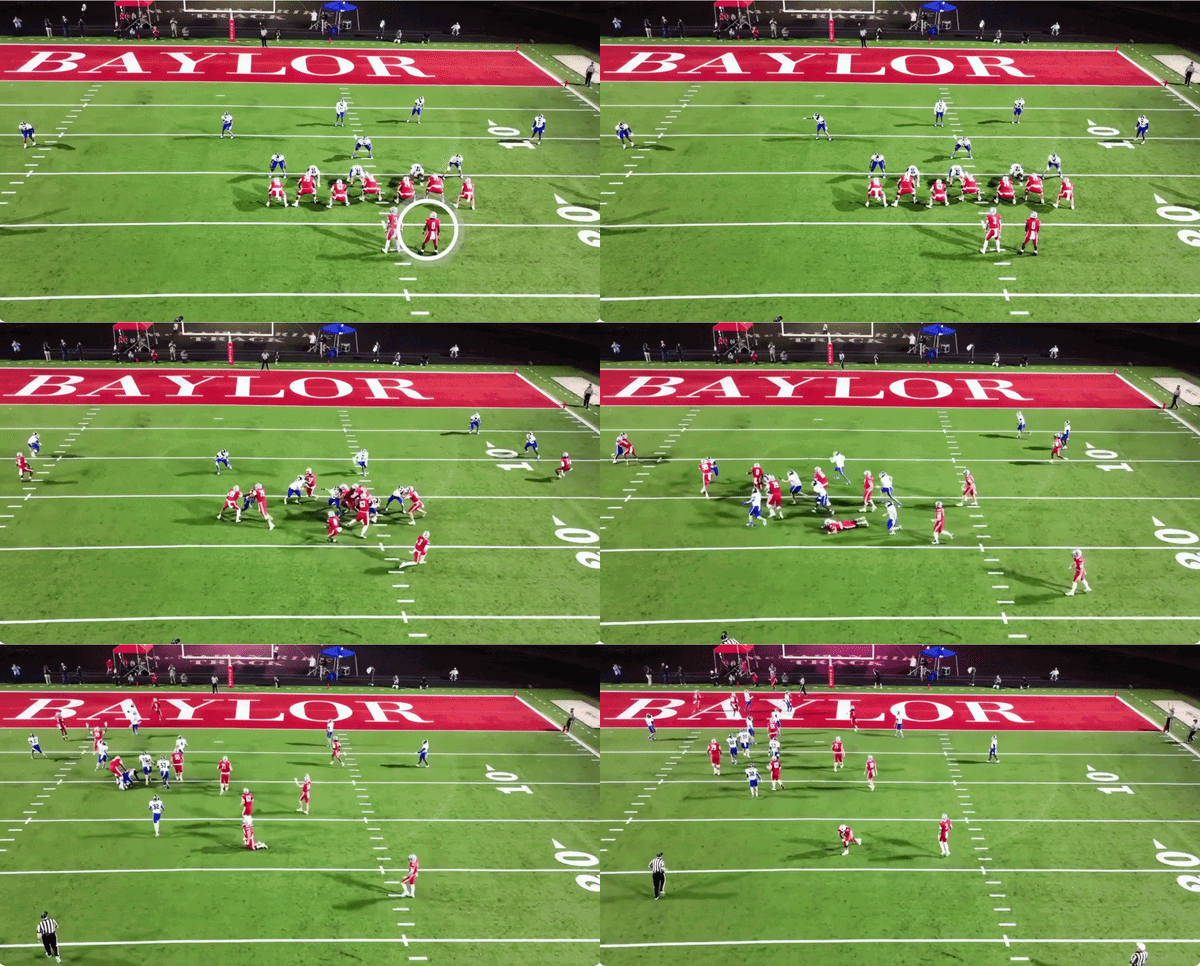
In play 2 you can see how patient he is in finding the crease and accelerating through the point of attack:
And on this third play you see his physicality and relentlessness:
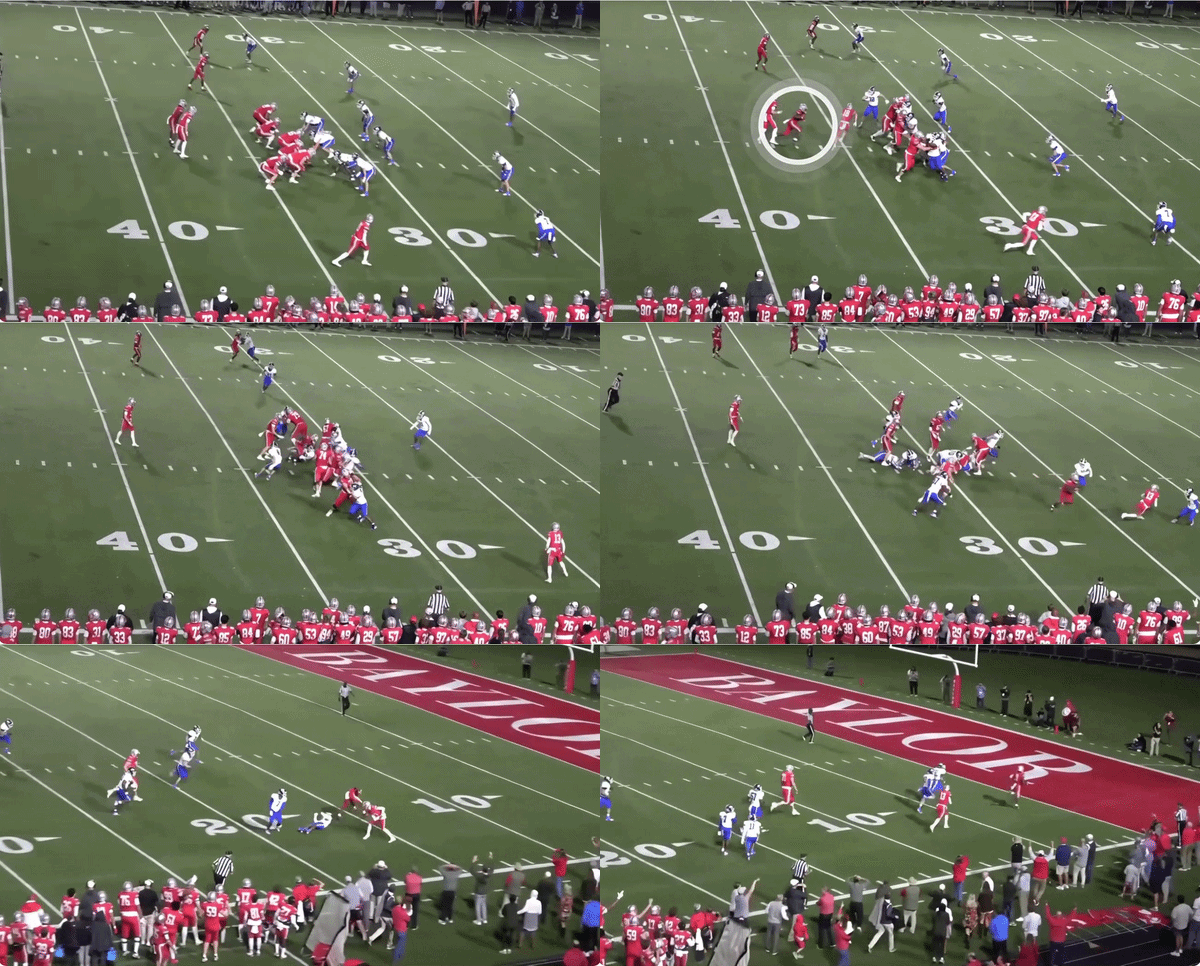
Haters will say that the level of competition these plays are made against is mid at best. And sure, I’d love to see him play against a 7A Atlanta school or some south Florida teams. But the point is a lot less about who he’s up against and a lot more about what he’s able to do. He’s a Swiss army knife. He has all the skills; if just one transfers to SEC-level play he will be a 1,000-yard rusher. From there the potential is unlimited.
Maybe Kinda Like*
These comparisons are based solely on the size, position, and rating of backs that have signed with UT this century. It’s hard to find a comp for DGG, considering his unique combination of skills and size
Jabari Davis (2001): At 6’ and 230 lbs., the J-Train was beefier than DGG and built like a true power back. He’s also the third-highest rated RB Tennessee has ever signed, and rushed for 1228 yards in a four-year career on the Hill, but seemed to be plagued by injury and never quite lived up to that lofty status he had coming out of high school.
Cedric Houston (2001): At 6’ and just 200 lbs., Houston might be a better size comparison with DGG than Davis. Coming to UT in the same class as Davis, Houston was lower-rated but the more productive back for his career, being a top-10 rusher in the SEC from his sophomore year on, and a 1,000-yard back in his senior season (although Davis had more career TDs than Houston did).
Gerald Riggs Jr. (2002):
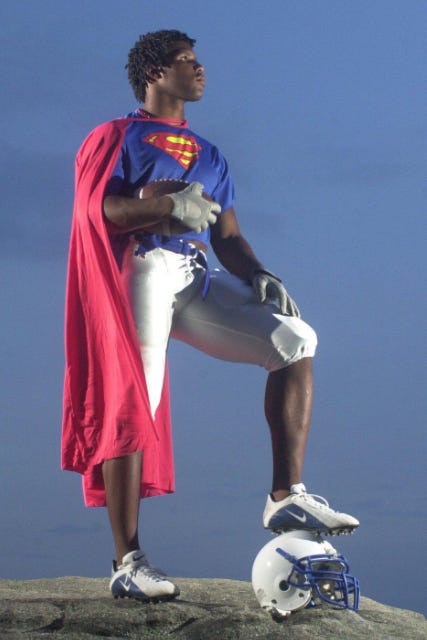
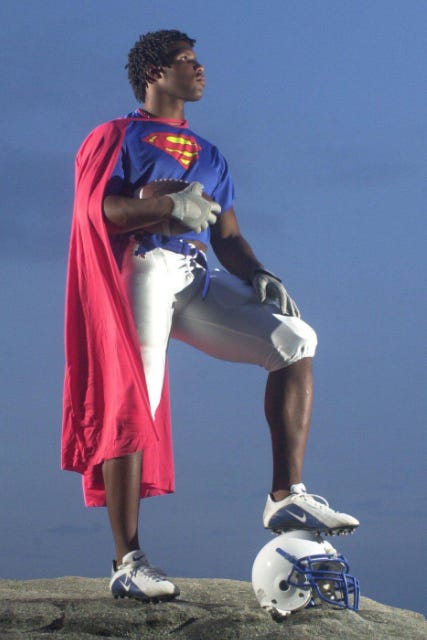
IF YOU KNOW YOU KNOW Speaking of can’t-miss backs from Chattanooga, Riggs was the highest-rated RB Tennessee had ever signed to that point, and the Chattanooga Times-Free Press published the above picture of Riggs in a Superman outfit on the cover of their high school preview edition prior to his senior year. I was living in Chattanooga at the time and fully bought into the hype. And while Riggs did run for over 1,000 yards his junior year (the same year Cedric Houston went over 1K), injury shortened his Preseason All-American senior season. (Riggs went on to win a Grey Cup with the Toronto Argonauts, so there is that.) At 6’ and 220, Riggs is a good size comparison with DGG, and he was higher rated—though I wonder is some of these early-2000s guys would be as highly rated with today’s standards?
Bryce Brown (2009): Brown was the greatest player in the history of sports. The highest rated player to ever sign with Tennessee or anywhere else, Brown was going to change the face of football forever. Of course, he lasted one season at UT before his coach went somewhere to be fired at an airport and Brown transferred to Kansas State (I just realized that Gerald Riggs Jr. had a longer pro career than Brown LOL). Brown rushed for 460 yards in his one season as a Vol, backing up Montario Hardesty. Size-wise a good comp for DGG, hype-wise UNTOUCHABLE.
Rajion Neal (2010): The one back on this list that was not a 5*. However, Neal came to Knoxville at 5’11 and 210 lbs., so probably the closest to DGG’s size. Neal also had ones of the most complete careers on this list, finishing with nearly 2800 yards and 24 TDs from scrimmage on some pretty bad Derrick Dooley teams.
Ty Chandler was another fairly high-ranked prospect that might’ve been another good comp height-wise, but was a good 30 lbs. lighter than DGG if his current weight of 220 lbs. is accurate. Jalen Hurd could be a good comp ratings-wise, but he was much bigger than Gabriel Georges. Like I said, it’s just hard to find a back Tennessee has had in the past with this set of skills at this particular size.
The hope is that DGG outshines this whole list. It is interesting that out of all these backs, the lower-rated Rajion Neal had arguably the best career at UT (Houston had a nice career, and Riggs had one good season). When considering how much the game has changed since the early 2000s, coupled with Josh Heupel’s offense, it is likely he will. After all, Tennessee has averaged 200 yards rushing/game since 2021 with backs that were considerably lower-rated prospects than Gabriel Georges (hence why they weren’t on the list).
Recruiting services like On3 compare Gabriel Georges to Quinshon Judkins, formerly of Ole Miss and Ohio State, due to the physicality they both show, with DGG likely being faster at this stage of his career than Judkins was. Chris Lowe has compared DGG to Herschel Walker, at least physically. And of course, DGG likes to model himself after another former Vol, Alvin Kamara. Coming out of HS, Kamara was not as highly ranked and at 5’10 and 195 lbs. was even smaller than Gabriel Georges. But when you watch them both with a football in their hands, you don’t have to squint to see the similarities.